

Olympic Animals
How the Olympic Games use animals for entertainment and sport

Welcome to Being Animal. This newsletter explores the intricacies of human-animal relationships. Through personal stories, commentary on current events, and thought-provoking debates, I hope to challenge your assumptions and deepen your understanding of how animals are treated in our society. How we treat animals matters— for our own health, for our planet, and for our sense of morality and humanity.
I want to make the world a better place for animals. To do this, we have to change how we think about animals. This week, like everyone, I have been captivated by the Olympics. But there is a long history of using animals for human entertainment and sport. In this piece, I reflect on what it means to rely on animals, and how we can evolve.
Like everyone, I have been completely captivated with the Olympic Games this week. I’ve watched gymnasts flip and spin, defying gravity. I’ve held my breath during track heats. I’ve scrutinized synchronized dives, googled rules for trampoline and beach volleyball, and learned about a handful of sports I never knew existed.
The Olympics are a fantastic opportunity to come together as a country. It’s also a time to appreciate the dedication and grit it takes to push the human body to its limits, to achieve greatness. Watching athletes put their whole soul into something, while putting their bodies on the line, is inspiring. The Games are full of heartwarming stories of determination and growth. The Olympics are undoubtedly a celebration of the indefatigable human spirit.
Just before the Olympics began, though, news emerged that the top British equestrian rider would not compete in the Games because a video had emerged of her whipping her horse. The New York Times reported that the video showed her “repeatedly strik[ing] a horse being ridden by another person as an onlooker laughs.”
The video resulted in immediate backlash, including a petition to remove equestrian from the Games to prevent future instances of cruelty.
At its best, equestrian and dressage demonstrate the beauty and grace of a strong human-horse bond. But when glory and international fame are on the line, the pressure to win can create dangerous incentives.
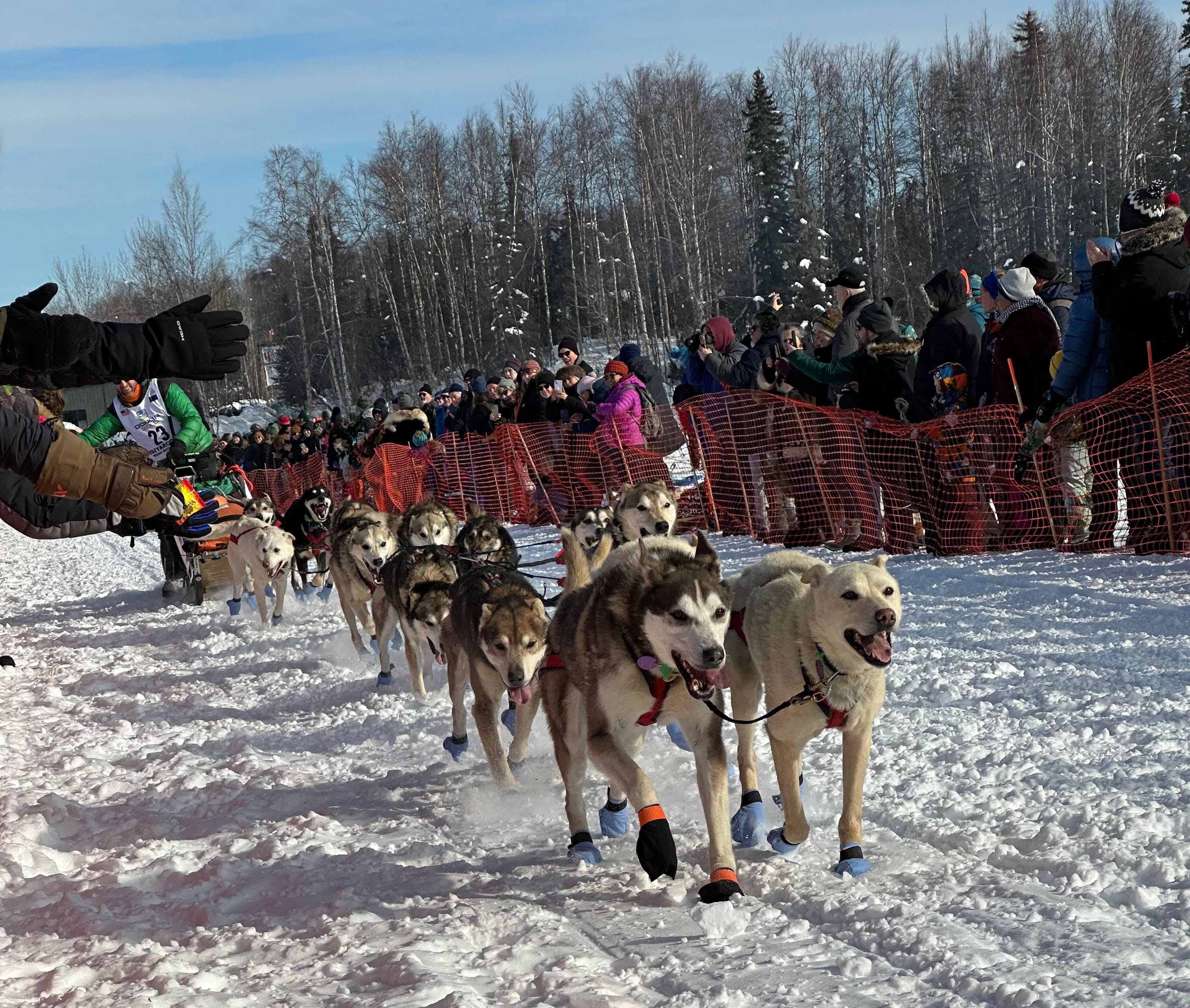
The video and backlash have made me reflect on how we use animals for entertainment and sport. As research for my upcoming book, I went to the start of the Iditarod Dog Sled Race in Anchorage, Alaska, a thousand-mile race across the Alaskan Interior that takes over a week. In a similar vein as with equestrian, proponents of dog sledding argue that the sport requires extreme human endurance, trust in the dogs, and respect and mutual care for the team. People say the dogs want to run; it’s part of how they were bred. But opponents cite to the very real harms that result; dogs suffer and die. Three dogs died during this year’s race alone.
The question arises: is the good of the sport worth the harm to the animals?
Equestrian is not the only time animals have been used for sport at the Olympics. Animals actually have a long history as athletic props in the Olympic Games. In ancient games, wild animal hunts and animal sacrifices were included as part of the competition. But even in modern times, the games have included animals beyond horses.
In 1900, the Olympics included pigeon shooting. Competitors would aim and shoot at live pigeons who were released from boxes and would try to fly away; the goal was to kill as many as possible. The gold medalist won by killing 21 pigeons. Throughout those games, over 300 pigeons were killed in total.
Running Deer Shooting was an Olympic sport from 1908 to 1948. In this sport, they didn’t shoot live deer, but shot at deer-shaped targets. Though no animals were killed, the symbolic effect of shooting at deer instead of shapeless targets powerfully reinforced the idea of animals as victims.
Dog sledding was debuted as a demonstration sport at the 1932 Olympics, in Lake Placid, NY. Similarly, skijoring, a sport where horses pull humans on skis, was debuted as a demonstration sport in 1928. Neither have been officially added to the list of Olympic Sports, but their inclusion demonstrates the variety of ways humans build animals into the competitive world of sport.
And of course, animals have appeared in more symbolic ways throughout the Games. Animals have featured in opening ceremonies, and have been repeatedly selected as mascots for the Games.
Animals are undoubtedly part of how we celebrate ourselves as human athletes at these games. But the use of animal performers as athletes also extends far beyond the Olympics. Rodeos, circuses, and horse and dog races all rely on animals and human-animal relationships for entertainment and sport. In my upcoming book, I write about animal festivals around the country that use animals as a central source of entertainment, like rattlesnake roundups and frog jumping contests. These types of events are shockingly common.
The ethical questions about forcing animals to compete for human glory are growing more and more pressing. As we learn about animal sentience, and as we as a society become more in tune with animal experiences, we have to ask ourselves: is any sport worth animal suffering?
Luckily, we’ve seen good progress. Pigeon shooting and dog sledding are not in today’s games. The swift accountability and apology for the horse whipping demonstrates that such behavior is not socially acceptable, even if it still occurs.
And, in Paris, a remarkable sixty percent of the food served to athletes at the Olympic Village is plant-based.
The Olympics are a symbolically powerful event in our society. It matters what sports are included and which countries get to compete (and under what flag); these decisions are political. On one of the world’s largest stages, I think it also matters how we relate to animals at the games, because millions of people watch and learn from what happens here.
As you watch more of the Olympics this week, I hope you reflect on the value of athleticism and entertainment, and which bodies we put on the line for human glory. I admire athletes, like everyone does, and I love watching the feats of these amazing people. But I also hope we can continue to move towards a more compassionate future, where we don’t rely on animals for our entertainment.
This felt like a nice ski ride celebrating and critiquing the olympics ✊⛷️